Striped skunk (Mephitis mephitis) occurs across most of North America. Measuring between 20-30 in. total body length and usually weighing 5-10 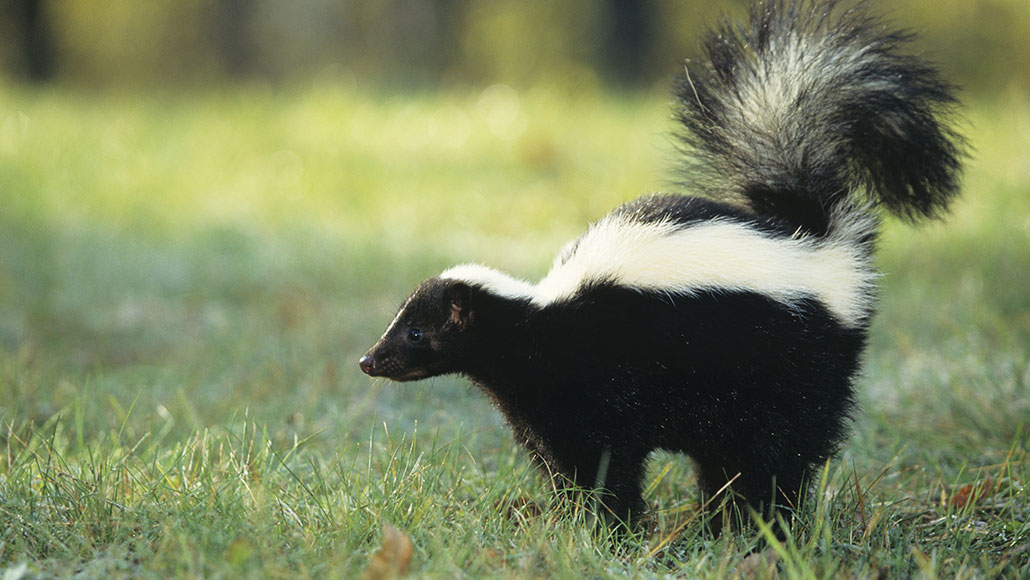 lbs. The color patterns of the fur vary greatly, but generally consist of a black base with a white stripe extending from the head which divides along the shoulders, continuing along the flanks to the rump and tail. The striped skunk inhabits a wide variety of habitats, particularly mixed woodlands, brushy corners and open fields interspersed with wooded ravines and rocky outcrops. While primarily an insectivore, the striped skunk is adaptable enough to incorporate other animals and even vegetable matter into its diet. Because of its formidable defensive capability, the striped skunk has few natural enemies. Mammalian predators typically avoid skunks, unless they are starving. They can also carry diseases harmful to humans and other animals. Skunks are considered by many people to be odorous and obnoxious pests that should be avoided at all costs and even eliminated on sight.
Pest Skunk Damage
Urban Skunk Problems
In fact, they can do much damage to property and also pose some minor health risks. Homeowners need to be aware of the habits of a skunk and known what to look for. so they can identify problem skunks.
In urban areas, they feed on pet food, garbage, fruit that has fallen from trees, and garden vegetables. Skunks become a nuisance when their burrowing and feeding habits cause problems for humans. Skunks use any sheltered place as a den including burrowing under porches or buildings by entering foundation openings, unused buildings, barns and even, attics of buildings. Skunks dig holes in lawns, golf courses, and gardens to search for insect grubs found in the soil. Digging normally appears as small cone-shaped holes or patches of up-turned earth, up to 3 to 4 inches in diameter.
They can cause some major problems for people. Skunks can be destructive and can cause some issues to pets. Many people are more concerned about the smell of a skunk, which is very strong and will last for along time. All skunks have the ability to discharge a nauseating musk from their anal glands. Skunks will spray as a defense mechanism if they are threatened or cornered. They can discharge their musk several times with accuracy to about 10 feet. Pets often are sprayed when they confront skunks. When skunks take shelter under buildings, their odor can make them an intolerable nuisance.
The spray can cause intense nausea and vomiting and if someone is sprayed in the eyes, it can cause blindness. The spray contains sulfuric acid, making it very potent and it will cling to objects. Eliminating the smell is not easy, especially if a person or pet has been sprayed. Its often easier to immediately remove nuisance skunks that wait for the problem to escalate
Disease from Skunks
The striped skunk is one of the major carriers of the rabies virus, second only to raccoons in the US where skunks are 25% of annual cases. Cases of rabies in this species are generally epizootic and recurrent. In regards to health risks for humans. Skunks can carry rabies and can transmit the disease to humans as well as other animals. It can be very difficult to know whether a skunk is infected since they can be seen at all hours of the day, so it is best to avoid contact with their saliva.
They are also host for the canine parvovirus and may also suffer from leptospirosis. These are just some of the diseases they can carry which they can expose to domestic pets and livestock.
Agriculture skunk damage
Skunks like poultry and eggs and, when circumstances permit, raid chicken houses and poultry yards. Especially in winter and spring months, the striped skunk will supplement its diet with eggs and the chicks of ground nesting birds. This can cause losses to poultry operations.
Skunks also may cause damage in agricultural situations. When in season, the skunk will also consume vegetable matter, such as unripened corn, mushrooms, apples, blueberries, black cherries, ground cherries, and nightshade. They may even be responsible for damage to beehives