Rock Doves or Pigeons (Columba livia), can vary in color, generally they have dark bluish-grey head, neck and chest with glossy greenish and reddish-purple iridescence around the neck and wing feathers they are 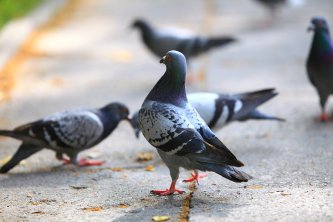 around 12″ long and weigh just under a pound (9-13 oz.).
Pigeons naturally inhabits sea-cliffs and mountains but today pigeons find the ledges of buildings to be a substitute for sea cliffs, have become adapted to urban life, and are abundant in towns and cities throughout much of the world.
Pigeons breed when the food supply is abundant enough to support it, which in cities and on farms this can be any time of the year…up to six times per year.
Pigeons are also responsible for millions of dollars in costs of repairing damage that occurs every year on buildings, roofs, machinery, vehicles, ventilation systems and a lot more. Due to their abilities to create large amounts of excrement and to carry disease, combined with crop and property damage, pigeons are largely considered a nuisance and an invasive species and require professional pest removal
Problems Causes by Pigeons
Disease from Nuisance Pigeons
Birds carry disease-causing microorganisms and contaminate areas with their droppings, feathers or external parasites such as mites. Droppings are widely considered the most serious problem that comes from a bird infestation. Pigeon droppings, can carry more than 60 transmittable diseases and dangerous parasitic organisms. Even inhaling microorganisms found in dried pigeon droppings can cause a number of diseases.
This can be very dangerous to people especially employees in areas with high pigeon populations as they are routinely exposed. Some of the more common and serious transmittable diseases are: Salmanella, Cryptococcosis and Histoplasmosis.
Pigeon Problems on Farms
Farms are highly susceptible to pigeon problems as they have ample amounts of food and nesting areas.
Bird droppings in feed have been shown to spread pathogens including E. coli, salmonella, cryptococcosis and histoplasmosis. There are 81 strains of salmonella that affect cattle. Calves two to four weeks old are most apt to contract severe infections. In mature cattle, Salmonella which infects  the intestinal tract of cows and can be serious, even fatal. It may cause abortions, or a decrease in weight production. Salmonella may be transmitted by direct contact with birds, consumption of feed or water contaminated by bird feces, or inhalation of dried bird droppings. Many of these pathogens are potentially lethal and capable of being spread to humans.
Birds often carry avian tuberculosis which is nearly identical to the bovine strain and is spread through their feces. It is not uncommon for cows exposed to bird droppings to show false positive test results for bovine tuberculosis, resulting in entire farms being unnecessarily quarantined.
Birds can be very selective about what they eat, preferring the more expensive components in rations, such as protein pellets or grain, and seldom consume roughage. This substantially alters the ration formulation, resulting in sub-optimal feed that negatively effects digestion and growth rate of cows.
Pigeons and other pest birds only consume specific components of TMR, causing an imbalance of nutrients. A ration can lose up to 31 percent of the net energy for lactation in the TMR in only 30 minutes. Dairy operators reported feed losses valued at US$55 per cow. Bird depredation of cattle feed may result in nutritional depletion of feed, which may impact milk production. Depenbusch et al. reported increases in daily production costs of $0.92 per animal at a Kansas feedlot due to feed consumption by starlings.
Damage to Buildings
Droppings can damage property as well, discoloring building and car paint, ruining wood, clogging gutters, staining fabric, and shorting out electrical equipment. Aside from causing physical damage, pigeon droppings also cause damage to a company’s image or a home’s curb appeal.Pigeon droppings and nesting materials accumulate and end up causing serious damage when nothing is done.
Pigeon droppings like most bird droppings naturally have high acid content. When left to accumulate, they wear out most roofing materials resulting in leaks. The high acid content also damages and weakens structural components of the building possibly leading to collapse. Pigeons nesting in rain gutters, roof corners or drains, create blockage causing accumulation of standing water; this has also been known to cause leaks and roof collapse.
Pigeons love to roost in attics of houses, restaurants, apartments and just any buildings that have exposed openings. They build nests and accumulate droppings which eventually cause a ceiling to become damages from deterioration and this leads to collapse when the weight becomes too much over time.
The accumulation of nesting materials which often constitute twigs, straw and dried droppings make very flammable material. The flammable material will ignite when the pigeons build these nests inside electric signs or on any other machinery that is likely to ignite them. Electric sign companies have often been victims of sign fires caused by nesting materials from these birds.
Damage to Other Property
The acidic pigeon droppings have also been known to cause great damage to industrial machinery, air conditioning equipment, insulation, siding bridges and overpasses and so on. When such damage occurs in machinery, it poses a dangerous health-risk to any worker who works around it
Paint finishes on vehicles mat be damages by pigeon droppings simply wearing away the protective coating and the paint. When the droppings sit on the paint for long hours they cause even more damage to the vehicle.
Pigeon nests in ventilation systems and chimneys resulting in serious damage from the blockage. This can spread diseases via the system or block the flow of air, something that can actually have fatal consequences in case of very serious contamination of the air such as carbon monoxide contamination.
Pigeon droppings and pest pigeons flying around have been known to contaminate the chemicals and liquids being used in the manufacturing process. Food that has been packaged could also be contaminated resulting to a loss of millions of pounds as a result of waste.
Whether alone or in large numbers, pigeons make noises for hours on end. These noises can be annoying, such as when you’re trying to sleep for example. But they can also be financially detrimental, such as when customers decide that they don’t want to return to a business because of the pigeon problem.